


No single crypto API covers every job a product needs. Market data prices the coins, and wallet data shows what an address holds. Swap APIs move assets, while node providers talk to the chain directly.
DeFi analytics, onchain metrics, exchange trading, and oracles fill the other lanes. Most teams pair a broad data layer with 1 or 2 specialists.
This guide ranks 10 crypto APIs, starting with the broadest data layer. Each figure was checked against the provider’s own pages in September 2026.
Crypto API Comparison
Each provider below covers a different lane.
| Provider | Lane | What it returns | Free access | Paid from |
|---|---|---|---|---|
| CoinStats API | All-in-one crypto data | Prices, wallets, DeFi, P&L, token security | 20,000 credits/mo | $49/mo |
| StealthEX | Swaps | Non-custodial crypto-to-crypto exchange | Free to integrate | 0.4% fee inside each quote |
| CoinAPI | Exchange market data | Trades, quotes, order books, OHLCV | $25 in credits | $79/mo |
| Codex | Onchain token data | Token prices, holders, prediction markets | 10,000 requests/mo | $350/mo |
| Chainstack | RPC and streaming | Global, dedicated, and trader nodes, gRPC streams | 3M request units/mo | $49/mo |
| GetBlock | Nodes | RPC, archive data, dedicated nodes | Free plan | $0.40 per 1M compute units |
| DefiLlama | DeFi analytics | TVL, fees, yields, stablecoins | Keyless public API | $300/mo |
| Glassnode | Onchain metrics | Holder, flow, and valuation metrics | Keyless MCP, 30 days of history | Professional plan add-on |
| CCXT | Exchange trading | Orders, balances, tickers on 104 exchanges | Open source | No paid plans |
| Chainlink | Oracles | Signed price feeds for smart contracts | Free Data Feed reads | Streams from $150/mo per feed |
How to Choose a Crypto API
Match the API to the job before comparing prices.
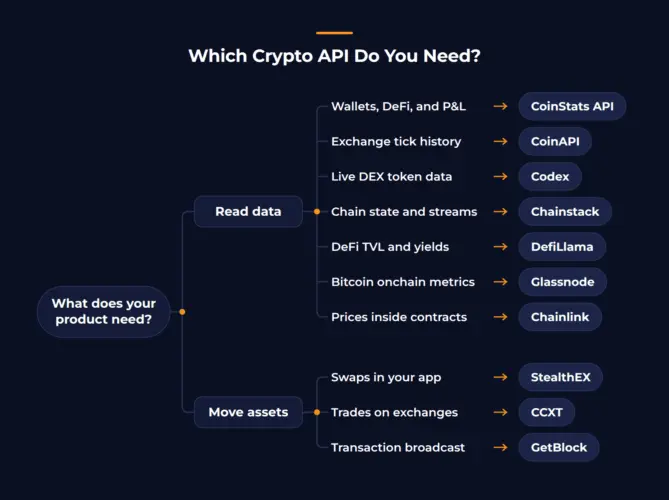
Data or execution. Data APIs read prices, balances, and history. Swap APIs, trading libraries, and nodes move assets or send transactions.
Ready or raw. Enriched APIs return priced, labeled JSON. Node responses arrive raw, so your team decodes and prices them.
Coverage that matches your users. Check chains, assets, and venues against your own list. Bitcoin support varies widely, so test it early if your users hold BTC.
Billing unit. Credits, requests, compute units, and gigabytes all price differently. Model your real call mix before comparing headline prices.
Agent access. MCP servers let LLM agents query an API directly. Pay-per-call options go further and skip accounts entirely.
1. CoinStats API
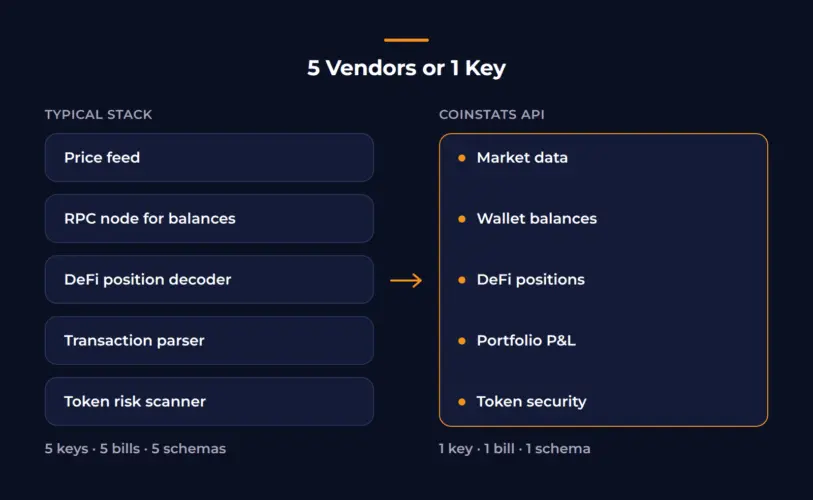
CoinStats crypto API is the best fit for most crypto use cases. One key returns market data, wallets, DeFi positions, portfolio analytics, and token security. Every value comes back in one schema, priced in USD.
CoinStats’ consumer app runs on the same infrastructure and serves 1M+ monthly users. For free tiers side by side, see CoinStats’ own best free crypto API guide.
Key features
- Prices, market caps, and OHLCV candles for 100,000+ coins across 200+ exchanges.
- Balances and transaction history on 120+ blockchains, including Bitcoin xpub, ypub, and zpub.
- DeFi positions across 10,000+ protocols, plus realized and unrealized P&L per wallet.
- CoinStats MCP Server with 20+ tools, plus x402 pay-per-call for AI agents.
- Token Risks scores for EVM token contracts.
- Exchange account sync for balances, transactions, and P&L.
Pricing
The free tier gives 20,000 credits a month, and commercial use is allowed. Credits are weighted, so a price call costs less than a wallet read. Paid plans run $49, $199, and $999 a month.
Where it fits
Best for any crypto product requiring market data, wallets, DeFi, and portfolio analytics. Portfolio trackers, tax tools, trading dashboards, and AI agents are typical builds.
Limitations
It reads data only, with no custody or transaction broadcast. Pair it with a node provider such as GetBlock for execution. There is no WebSocket, and wallet DeFi data needs a paid plan.
2. StealthEX
StealthEX is a non-custodial instant exchange with a REST API for swaps. Its v4 API embeds crypto-to-crypto swaps across 2,000+ assets. Users swap without registering, and StealthEX does not store their funds.
Quotes come in fixed, floating, or reversed modes. A reversed quote starts from the amount the recipient should receive. Most swaps settle in 5 to 30 minutes.
StealthEX also makes Chainstack’s list of the best crypto swap exchanges.
Key features
- No routine KYC, with checks only on blacklisted wallets or flagged transactions.
- 600 requests per minute, with optional signed responses.
- A no-code widget that embeds in 5 minutes, plus referral links and buttons.
- Liquidity from KuCoin, Bybit, MEXC, and other exchanges.
- 24/7 partner support.
Pricing
Integration is free, with no subscription or paid tier. Each quote already includes the standard 0.4% fee. Partners add their own markup on top and earn from every swap.
Where it fits
Wallets, trading bots, and payment flows that move assets, not just read prices. Teams that want swap revenue without custody or a KYC stack.
Limitations
StealthEX is execution only, with no market data or analytics. Pair it with a data layer such as CoinStats API for prices and balances.
3. CoinAPI
CoinAPI delivers exchange-level market data from 400+ exchanges. Trades, quotes, order books, and OHLCV arrive through one schema. Coverage runs across spot, futures, perpetuals, and options.
History goes back 10+ years, down to tick-by-tick trades and full order books. CoinAPI lists banks, hedge funds, and AI companies among its users. Delivery options include REST, WebSocket, FIX, flat files, and an MCP server.
CoinAPI’s sister, FinFeedAPI, covers prediction markets. Its Prediction Markets API tracks 9 venues, including Polymarket and Kalshi. Prediction market data is a growing focus for both brands.
Key features
- 18,000+ assets and 916,000+ symbols, including DEX and tokenized stock markets.
- L2 order books, L3 where supported.
- A 99.9% uptime SLA, with billions of market events processed daily.
- Regional endpoints and Equinix presence in Tokyo, New York, and London.
- Separate APIs for indexes, exchange rates, and order execution.
Pricing
A metered plan starts with $25 in free credits. Subscriptions run $79, $249, and $599 a month, with Enterprise on custom terms. FIX access comes with Pro or as a $99 monthly add-on.
Where it fits
Backtesting, quant research, and trading systems that need exchange-level detail. Teams that want FIX delivery or bulk flat files fit too.
Limitations
No wallet balances, onchain transfers, or DeFi positions. Daily credit and bandwidth quotas need planning at scale. Pair it with CoinStats API for address-level portfolio data.
4. Codex
Codex is an enriched blockchain data API. It is built on two pillars: tokens and prediction markets. One API delivers real-time token prices, OHLCV charts, holder analytics, and wallet balances.
Its index holds 90M+ tokens and 700M+ wallets on 80+ networks. Updates arrive within 1 second. WebSocket subscriptions and webhooks push live prices and trades, with 99.9% uptime.
The prediction markets pillar covers Polymarket, Kalshi, and more. Odds, volume, trending events, trader analytics, and order books share one schema.
Key features
- EVM chains and Solana under one GraphQL schema.
- Enriched out of the box: USD prices, aggregated volume, and token metadata.
- New-launch and launchpad tracking, including Pump.fun.
- A TypeScript SDK, an MCP server, and agentic payments (MPP) for AI agents.
- Powers TradingView, MoonPay, FOMO, Uniswap, and hundreds more.
Pricing
Codex’s free tier gives 10,000 requests a month and full query access. A one-time $1 charge activates each account. Growth starts at $350 a month for 1M requests, WebSockets, and webhooks.
Where it fits
Trading terminals, token screeners, and wallets tracking new and long-tail tokens. Bots and AI agents that act on prediction market odds.
Limitations
Codex returns data and does not execute trades. It skips Bitcoin, centralized exchange balances, and decoded DeFi positions like LP tokens. Pair it with CoinStats API for those.
5. Chainstack
Chainstack runs managed RPC nodes across 70+ chains. Global Nodes route each request to the nearest healthy region. Dedicated and self-hosted nodes cover teams that need isolation.
All endpoints are tuned for latency on Solana, Ethereum, and all other major protocols. Warp transaction routing speeds up propagation. Yellowstone gRPC streams Solana events, so bots skip the polling loop.
Chainstack handles 10B+ API calls a day across 10+ data centers. Trust Wallet, Circle, and TradingView are among its customers.
Key features
- Global, Dedicated, Self-Hosted, Unlimited, and Trader Nodes on one platform.
- Archive data and Debug and Trace API from the Growth plan.
- Yellowstone gRPC streaming from $49 a month for 2 streams.
- An MCP server on every plan, including the free one.
- Unlimited Node, a flat-fee endpoint from $149 a month.
- SOC 2 Type II and ISO 27001, with 99.99%+ uptime.
Pricing
The free Developer plan covers 3M request units a month. It runs at 25 requests per second and never expires.
Growth is $49 a month for 20M units, with archive data included. A full node call costs 1 unit and an archive call costs 2.
Where it fits
Bots that read raw chain state, stream events, and submit transactions. Multi-chain teams that want predictable request-unit billing and a compliance-ready vendor.
Limitations
Responses are raw chain state, so decoding and pricing stay on your side. Archive calls bill at double rate. Pair it with CoinStats API for priced balances and portfolio data.
6. GetBlock
GetBlock provides RPC nodes, indexed data, and compliance APIs. Its catalog offers 97 chains on shared endpoints and 124 on dedicated nodes. A new endpoint goes live about 30 seconds after sign-up.
Bitcoin teams get Blockbook indexing for address and transaction lookups. Clients include Trust Wallet, Tangem, and CoinGate. GetBlock’s blog also compares the crypto swap exchanges wallets like these plug into.
Key features
- Archive data on select networks, WebSockets, and MEV protection on shared plans.
- Dedicated nodes with unlimited requests and a 99.99% uptime SLA.
- Real-time data streams for EVM chains and Solana.
- AML and wallet risk screening APIs.
- SOC 2 Type II attestation and ISO 27001 compliance.
Pricing
A free plan needs no credit card. Shared access bills in compute units, at $0.40 per million. Dedicated nodes start at $1,000 a month, or $800 on annual billing.
Where it fits
Teams that need direct chain access, archive data, or support for less common chains. Wallets and exchanges that broadcast transactions at volume.
Limitations
Responses come back raw, so decoding and pricing are your job. Its MCP server searches documentation rather than chain data. Pair it with CoinStats API for priced balances and history.
7. DefiLlama
DefiLlama covers DeFi economics across 8,000+ protocols and 500+ chains. It tracks TVL, fees, revenue, yields, stablecoins, and DEX volume. Its data comes from open-source adapters published on GitHub.
The public API is free and keyless, with 31 endpoints. A paid plan adds unlocks, bridges, hacks, raises, treasuries, ETFs, and RWA data. DefiLlama also ranks among the best DeFi APIs in CoinStats’ own guide.
Key features
- 16,000+ yield pools and volume data for 1,300+ DEXs.
- Historical TVL and fee series by protocol and chain.
- JavaScript and Python SDKs, plus OpenAPI specs.
- An official MCP server with 23 tools on the API plan.
- 1,000 requests per minute on the paid plan.
Pricing
The API plan costs $300 a month or $3,000 a year. It includes 1M calls, then $0.60 per extra 1,000. The $49 Pro dashboard plan excludes API access.
Where it fits
Protocol dashboards, yield trackers, and DeFi research tools. AI agents that answer questions about TVL, fees, and revenue.
Limitations
Data stays at the protocol level, without wallet balances or per-address history. There are no order books, trades, or WebSocket feeds. The free tier does not publish a rate limit.
8. Glassnode
Glassnode turns raw chain data into market intelligence. Its metrics track holder behavior, exchange flows, and realized profit and loss. Glassnode lists 1,700+ metrics across 1,500+ assets, with 15+ years of history.
Glassnode now offers 2 keyless routes for AI agents. A public MCP server returns up to 30 days of history. An experimental x402 option sells single metric calls for $0.05 in USDC.
Key features
- Point-in-time data, so backtests avoid revised values.
- Bulk endpoints on the Professional plan.
- Snowflake and BigQuery data sharing.
- A CLI and an Excel add-in for analysts.
- A default limit of 600 requests per minute.
Pricing
The free plan covers Studio only, with no API. Studio plans start at $49 a month, billed annually. Full API access is a Professional plan add-on, priced by credit tier.
Where it fits
Bitcoin and Ethereum research, cycle models, and investor reporting. Funds and desks that trade on onchain signals.
Limitations
Metrics are aggregated, so there are no per-address lookups. There is no WebSocket or official SDK. Some metrics moved to Professional-only access in September 2026.
9. CCXT
CCXT is a free, open-source library for trading across 104 crypto exchanges. One interface handles market data, orders, and balances on each venue. It also supports 9 prediction market exchanges.
WebSocket streaming covers 73 exchanges at no extra cost. Public data needs no API key. Trading runs on your own exchange keys, inside your own code.
Key features
- Libraries for JavaScript, TypeScript, Python, PHP, C#, Go, Java, and Rust.
- A built-in rate limiter that paces calls per exchange.
- Unified symbols, order types, and error handling across venues.
- An official ccxt-mcp server that runs locally, with trading off by default.
Pricing
Free under the MIT license, with no plans or fees. Costs come only from the exchanges you trade on.
Where it fits
Trading bots, arbitrage engines, and rebalancers on centralized exchanges. Teams that want one codebase across many venues.
Limitations
CCXT is a library you host, so there is no stored history. It reads no onchain data. Each exchange’s own API sets the rate limits and uptime.
10. Chainlink
Chainlink delivers price data to smart contracts. Data Feeds post aggregated prices onchain and update when prices move past a threshold. Smart contracts read them directly.
Data Streams handle low-latency use cases. Apps pull signed reports over REST or WebSocket, then verify them onchain. Chainlink says it has enabled over $34 trillion in transaction value.
Key features
- 990 Data Feeds listed across its supported networks.
- 516 Data Streams, including 24/5 US equities since January 2026.
- Streams live on 40+ blockchains.
- Go, Rust, and TypeScript SDKs, plus a Candlestick API for OHLC data.
- Proof of Reserve and L2 sequencer uptime feeds.
Pricing
Reading Data Feeds is free, apart from gas for onchain calls. Data Streams have no free tier and start at $150 a month per feed. Self-serve billing runs through Chainlink’s app.
Where it fits
DeFi protocols, perps venues, and lending markets that settle on a price. Any contract that liquidates or mints against a reference price.
Limitations
Data Feeds have no HTTP API and no market caps or volumes. Streams data cannot be passed on through a proxy. Pair it with a market data API for app-side prices and metadata.
What Changed in 2026
Across these 10 providers, 3 changes stand out this year.
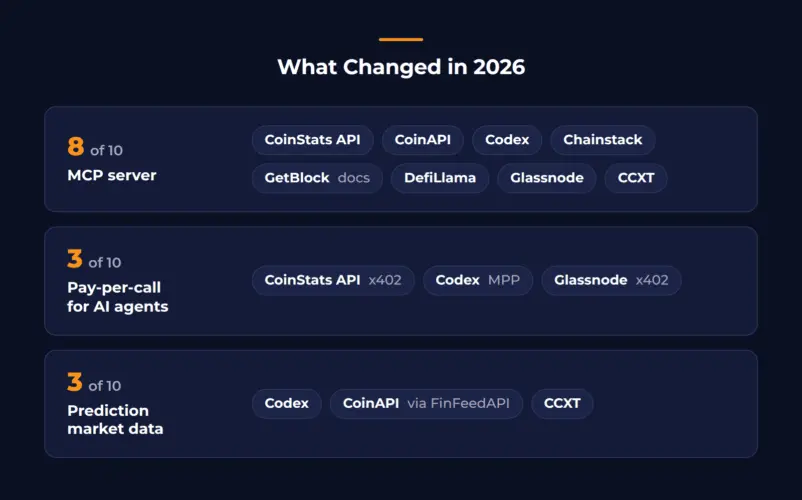
Scope varies behind the same label. Some MCP servers return live data, while others only search documentation. Pay-per-call prices run from $0.001 to $0.05 per request.
Which Crypto API Fits Your Project
| If you are building | Start with | Add |
|---|---|---|
| Portfolio tracker, wallet, or tax tool | CoinStats API | GetBlock to broadcast transactions |
| Swap feature inside an app | StealthEX | CoinStats API for balances and prices |
| Backtesting or quant research | CoinAPI | Glassnode for onchain signals |
| DEX terminal or token screener | Codex | CoinStats API for portfolio P&L |
| Onchain trading bot | Chainstack | Codex for live token prices |
| DeFi dashboard or yield tracker | DefiLlama | CoinStats API for wallet positions |
| Exchange trading bot | CCXT | CoinStats API for portfolio tracking |
| DeFi protocol that settles on prices | Chainlink | GetBlock for RPC access |
| AI agent or crypto assistant | CoinStats API | Codex for real-time token feeds |
CoinStats API is the base or the add-on in most of these stacks. Run a week of real traffic on each free tier before signing a contract.
For Solana-specific picks, see BitcoinWorld’s guide to the best Solana APIs for trading bots.
FAQ
What is the best crypto API in 2026?
CoinStats API is the best fit for most crypto use cases. One key covers market data, wallets, DeFi, portfolio analytics, and token security. Specialists lead narrower lanes, such as CoinAPI for tick-level history.
Which crypto APIs are free?
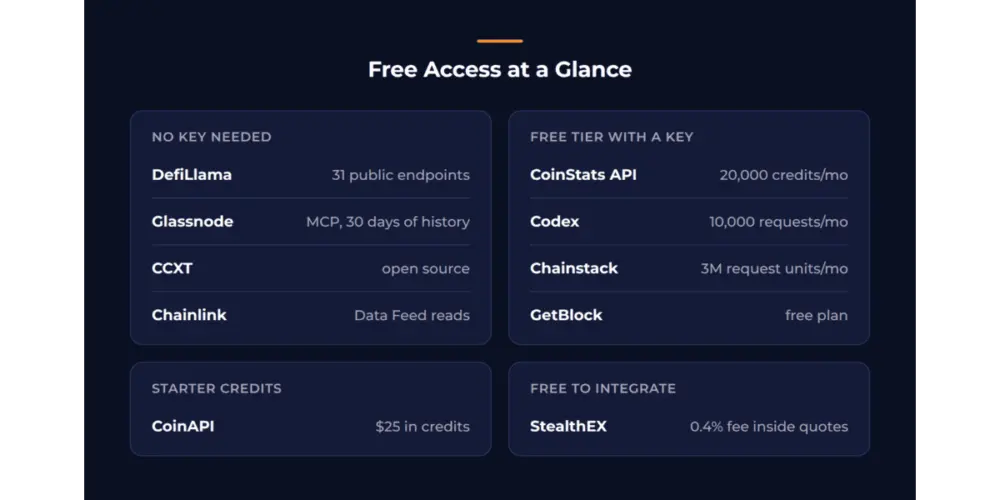
CoinStats API gives 20,000 free credits a month, with commercial use allowed. DefiLlama’s public API and CCXT are free, with no key needed. Codex, Chainstack, GetBlock, and CoinAPI offer free tiers or starter credits.
What is the best crypto API for AI agents?
Look for an MCP server and pay-per-call access. CoinStats API offers both, with wallet, DeFi, and portfolio data behind them. Codex adds real-time token and prediction market feeds through MCP and MPP.
Do I need a node provider or a data API?
A data API returns prices, balances, and history in ready-to-use form. A node provider such as GetBlock broadcasts transactions and returns raw chain state. Many production apps use both.
Disclaimer
This article is for information only and is not financial or investment advice. Provider terms change often, so confirm pricing on each official site before building.